Out of Exile: Voxtrot on the Band’s First New Album in Almost 19 Years
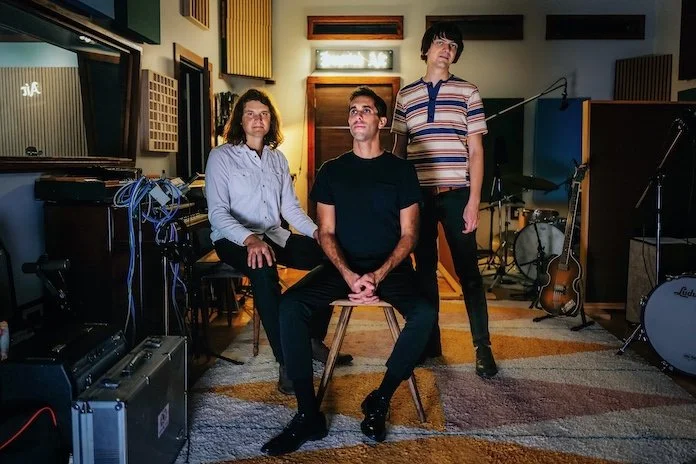
Setting aside whatever spiritual or scientific discourse may exist on the subject of destiny versus free will, Voxtrot frontman Ramesh Srivastava has determined his life—at least from a chronological standpoint—long abandoned any semblance of predictability. “I’m always surprised that life is not what you think it is, that there’s always another plot twist,” he says. “The vision you have of exactly how it’s going to turn out, what it’s going to be, is just not it.”
With a tendency of pulling at the strands of his hair at the top of head when speaking, Srivastava is sitting in his home in Lockhart, TX, attempting to explain the circumstances surrounding the last two decades of his life, how the band he formed became a lauded, indie rock darling of the late aughts’ blog-rock boom; how they burnt out and dissolved after just a handful of EPs and a lone full-length record; how they reunited 12 years later to an audience of enthusiast devotees both old and new; all of it culminating in the release of Dreamers in Exile, the band’s first new album in roughly 19 years. “I went through this kind of long, crazy journey to get back to this place, you know? Back to this place with my bandmates again. The ecstasy of the relationship has come back around. It’s like a miracle.”
At the beginning Srivastava had little to no expectation for what Voxtrot was or what it could potentially be. For him—alongside members Jason Chronis, Matt Simon, Mitch Calvert, and Jared Van Fleet—it was about a conglomeration of musical touchstones, mining the influences of bands like Belle and Sebastian and The Smiths and densely blending them with a charming earnestness that could make even the most wall-flowered music geek attempt their own version of dancing. By 2005 the band released two critically acclaimed EPs, Raised by Wolves and Mothers, Sisters, Daughters & Wives. As Peter Baker wrote about the band in an essay for The New Yorker in 2023, “Voxtrot was the bright star in the blog-rock firmament. Their lyrics were smarter; their arrangements were tighter. Most importantly, the warmth on their songs’ surfaces wasn’t just on the surface; it was internally generated by solid coils of feeling, wound tight and throwing off heat.”
With so much potential and anticipation around what the band could produce within a full-length album, even when said record resulted in just a series of mixed reviews, to Srivastava and the band it felt like a crushing disappointment. With interpersonal relationships straining and their label dropping them from its roster, “it was this domino effect of loss of confidence,” recalls Srivastava.
By 2009 Srivastava knew the band was coming to an end. “I remember very distinctly that I was in New York City and I was staying with our manager James and we were going to this show at The Bell House,” he says. “I just remember saying something to the effect of, ‘It’s just obvious that it’s run its course.’ I felt like the only thing left to do was find the best way to end it, to find the correct way to say goodbye.” Voxtrot played its last show in 2010 on Srivastava’s 27th birthday.
Despite the end of what had been such a promising, shared endeavor, Srivastava says he was hellbent on having a solo career that was going to be as successful or even more so than Voxtrot. Moving to Los Angeles and supplementing his income by working a variety of service industry jobs, teaching school, and working as a professional songwriter (his most notable credit, “Now I’m in It,” from HAIM’s Grammy-nominated album Women in Music Pt. III) Srivastava successfully released two albums, The King in 2014 and Eternal Spring in 2022.
Though appreciative of the professional wins when they came, Srivastava sadly admits he spent the majority of his post-Voxtrot days in relative anonymity, forcing a reexamination of how he perceived himself and what his measurement of success truly was. “I was driven to turn inward,” he says. “Sometimes it takes a really challenging juncture in life to drive you to finally pay attention to your inner life. I’m glad that I was driven there, because I feel much more like I have an anchor in myself, and I didn’t have that when in Voxtrot 1.0.”

During those same intervening years the idea of a Voxtrot reunion would often come up between Srivastava and his former bandmates, who he still remained in contact with. More often than not it was Srivastava who ultimately squashed the prospect. It wasn’t until the isolation of the pandemic and Srivastava scouring social media and seeing that Voxtrot still had a presence—cover performances, quoted lyrics, tattoos—that he started to realize just how much love for the band still remained. Add to the fact that Srivastava started having literal recurring dreams about Voxtrot reuniting, he says, “At a certain point I couldn’t think of any reason to not play these songs again.” In January of 2021 Srivastava committed to the idea and emailed Chronis, Simon, Calvert, and Van Fleet. By the following year, in conjunction with the release of two archival compilations (Early Music, a combination of the band’s EPs, and Cut From the Stone: Rarities & B-Sides) Voxtrot returned to the stage for a seven-date reunion tour, their first live performances in 12 years.
The response to the shows was overwhelmingly positive for Srivastava and the band, citing the fact that they weren’t just playing to devoted groups of elder millennials who had an already established love for their catalog of songs, but younger, Gen Z-era concert goers who had discovered Voxtrot when they were no longer active.
While a collective agreement had been made amongst the band that any discussion of anything beyond the tour—including writing and recording new music—would be held off until the last show, Srivastava says, “I was always taking the temperature. I would have one-on-one conversations with everyone, and not even intentionally, it would come up. It felt like in Congress when they secure a vote before the official count.”
Coordinating their respective calendars to accommodate Calvert and Van Fleet’s flights to Lockhart, over months the members of Voxtrot met for a series of week-long writing and recording sessions within the makeshift studio Chronis had outfitted behind his house. “We started out recording what were supposed to be the demos for the record,” says Srivastava. “But Jason, unbeknownst to the rest of us, he wanted to make them so good that there’d be no reason to re-record them elsewhere.”
Like Voxtrot songs of the past the new tracks draw inspiration from a variety of cultural touchstones and sources, from the underground scene of Cold War Berlin during the 1980s, to the real-life romance of Yves Saint Laurent and Pierre Bergé, to the 1961 film Paris Blues starring Sidney Poittier and Paul Newman. Less like before, Srivastava also injects far more direct references to his own life and experiences. On the album’s opening track, “Another Fire,” he sings of his Indian ethnicity: “They judge the brown skin / like birth was my sin.” On “Fighting Back” he acknowledges a diminished sense of self-worth when he worked as a courier delivering couture outfits to the rich and famous for red carpet events: “Delivering dresses to the stars / Rodeo Drive will shame you into nobody.”
“I was afraid to bring more of myself, to make it anything but just fun,” admits Srivastava. “I was afraid that I was imposing on my bandmates. But I guess for someone who’s listening to Voxtrot, if they have an emotional relationship with Voxtrot’s music, they probably want the truth. It’s scary to risk not just being entertaining, and it’s great that the rest of the band were up for it.”
New avenues were also paved instrumentally. While Voxtrot dabbled with the utilization of synthesizers in the past, on Dreamers in Exile they are implemented predominantly throughout the record. “I love electronic music,” says Srivastava. “I DJ. When I lived in Glasgow I was basically a full-time club kid. I love it and I always wanted to bring that to Voxtrot. But I was afraid that it would just be a hard no. But again, once we heard it, once we tried something we were like, ‘Whoa, that’s so fucking cool. Let’s just keep going down this path.’ I wanted to have new sounds. I want it to go to new places.”
Ultimately Dreamers in Exiles succeeds in that sought-after balance. It maintains its signature energy without feeling like it’s trying to be what it was all those years ago. It finds new means of sincerity without overshadowing its levity and playfulness.
Embracing change, letting things organically evolve into whatever it ultimately becomes is something Srivastava is still learning to accept, that something he’s had so much love for is actually getting the opportunity to continue. “I’m still stepping into the shoes of my own belief,” he says. “I believe fully in what we’ve created, and I know that there’s all this potential that I don’t even know what it looks like yet. But because of difficulties that I’ve experienced in the past I still have this fear around it. Even to say this is a continuation—even to say that even though it’s true—I’m still afraid to say it. There’s still a fear hurdle that I have to overcome, and the only way to overcome it is by just doing it.”